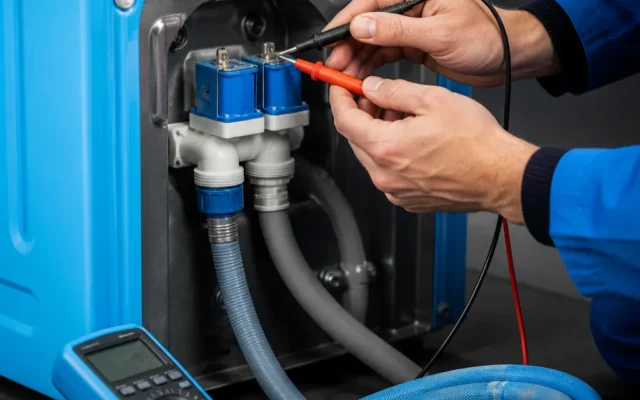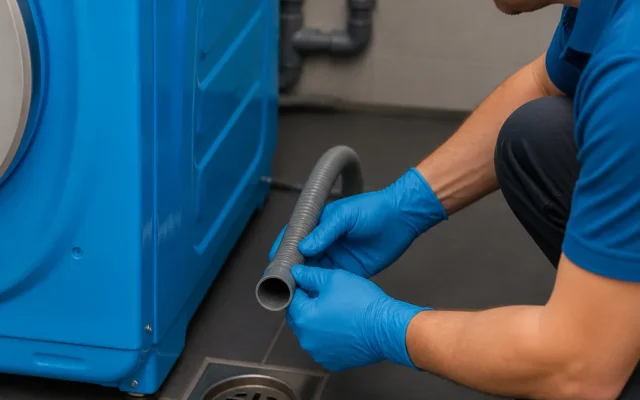
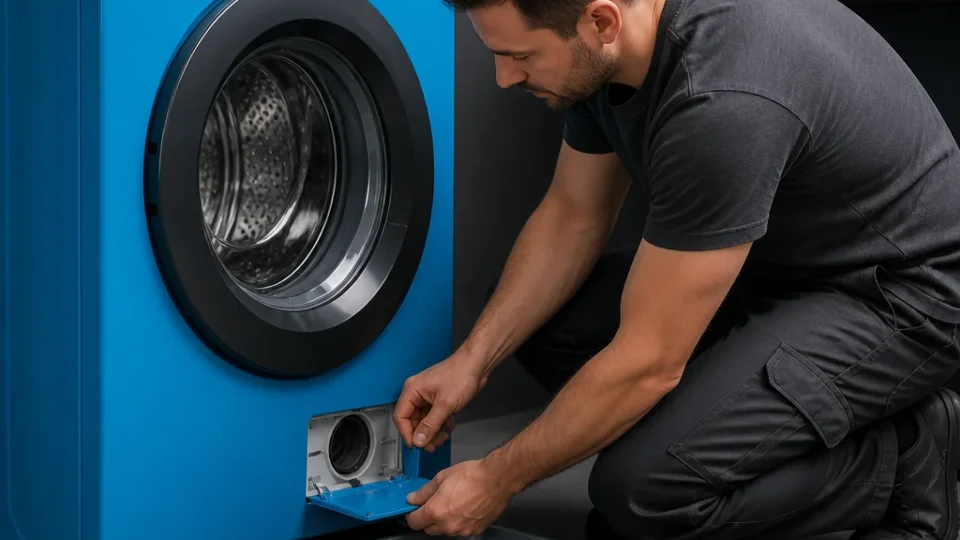
The cycle ends, the drum is still holding water, and the display is either showing OE or nothing at all. On an LG washer, the two main components you can check without opening the cabinet are the drain pump filter and the drain hose. Read the code on the display first, because it tells you what the machine was trying to do when it gave up.
Why your LG washer stops with water still in the drum
An LG washer does not give up the moment the drain slows down. lg.com describes the control board watching the water level and stopping the machine when the level has not come down inside a timed window: typically 13 minutes on top-load models and around 10 minutes on front-load models. That is worth knowing before you start pulling panels off, because it tells you what the machine has actually measured. It knows the water did not leave in time. It does not know what stopped it, and that part is still found by hand.
Everything below is specific to LG machines and to the OE code they use. If the washer in your laundry room carries a different badge, the same fault on a Samsung washer is covered in its own guide.
What the OE error code on the display means
OE stands for Water Outlet Error: lg.com states that it means the machine failed to lower the water level inside it within the time allowed for draining. The code names an outcome rather than a part. It tells you the water did not leave, not what held it back, so the checks below are ordered by how easy each one is to reach rather than by how likely it is.
What to have ready before you start
Put a couple of towels on the floor in front of the machine and find a shallow, wide container such as a roasting pan or a baking dish, because on a front-loader the hose you will be draining sits close to the floor. Have somewhere to put wet laundry, since it is coming out before the machine goes back together. Nothing else here needs buying.
Warning: Unplug the washer first
Before any panel comes off and before any water comes out, pull the plug. trueprohome.com puts unplugging the unit at the head of its procedure, ahead of draining and ahead of touching the filter.
How to get the standing water out first
On a front-load LG the water comes out before the filter does. Behind the small service panel at the bottom front there is a short hose alongside the filter cap. lg.com calls it the residual water hose and trueprohome.com the black emergency drain hose; pulling it out and taking its cap off empties the drum into your container. The drum may hold more than one panful, so cap the hose again while you empty the pan, and carry on until it runs dry.
A top-load LG has no lower service access door or external filter to open, as its drain pump is mounted underneath the tub assembly inside the cabinet. Draining issues on these models are instead addressed by checking the drain hose for kinks and verifying proper installation height.
How to clear the drain pump filter
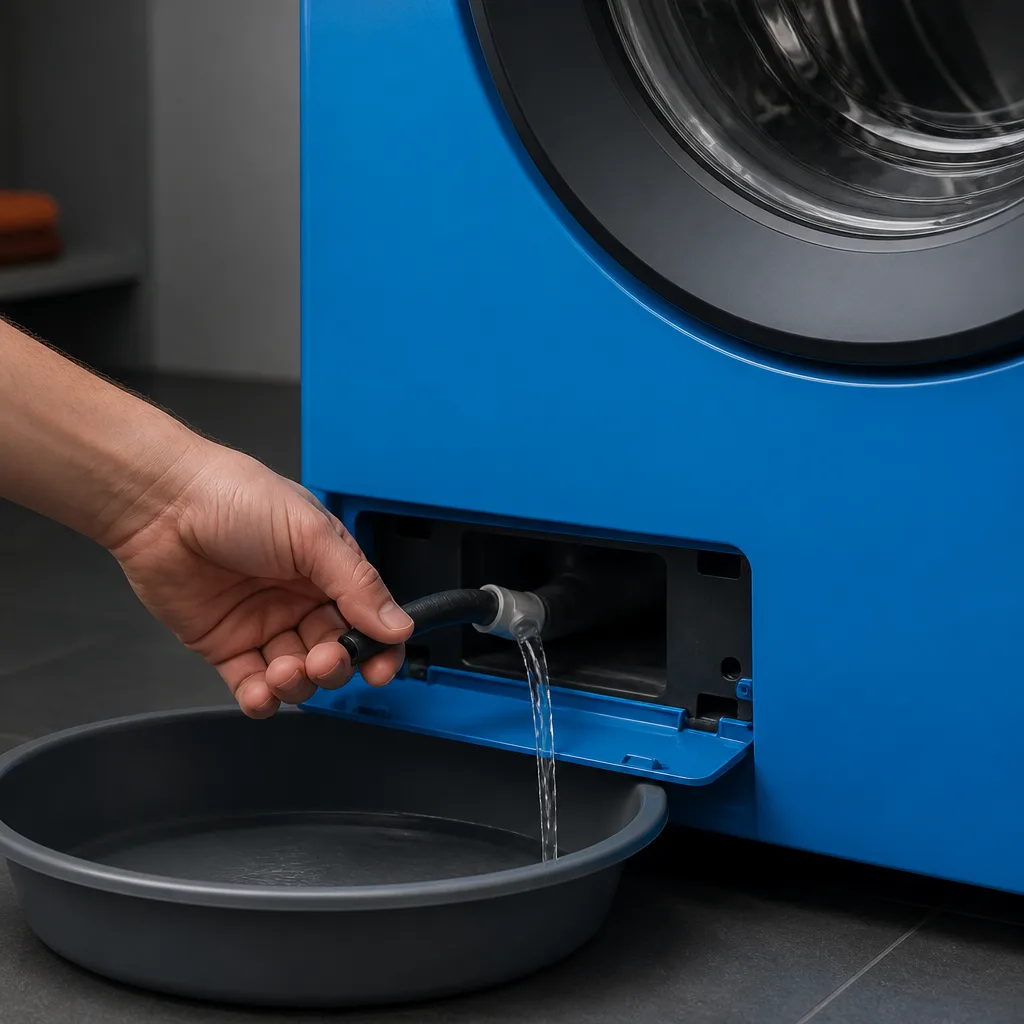
This is the part of the drain you can reach, and on a front-load LG it is the one lg.com describes servicing from the outside: the drain pump filter sits behind that same bottom-front panel, behind a cap you turn by hand. trueprohome.com sets out the sequence, and with the drum already empty and the machine unplugged, the rest of it is short.
Keep the pan under the opening and twist the filter cap counterclockwise, then draw the filter out, because a little more water comes with the filter itself. Clear whatever has collected in it: lint, hair, coins, the things that come out of pockets. Check that the impeller behind the filter turns freely when you move it by hand, and wipe out the housing the filter sits in before the filter goes back.
Screw the cap back in clockwise until it is firmly seated, push the small drain hose back into its clip, and close the panel. An impeller that would not turn by hand is worth noting rather than forcing. That is the far end of what the service panel gives you access to, and it belongs in what you tell whoever works on the machine next.
Where the filter is on a top-load LG washer
There is not one to reach. lg.com states that LG top-load washers have no external drain pump filter and no lower service access door, and that the drain pump is mounted underneath the tub assembly, inside the cabinet. If you have been looking for a panel at the bottom front of a top-loader and finding nothing, that is the machine, not you. On a top-load, the check still open to you is the drain hose at the back.
How to check the drain hose and the standpipe behind the machine
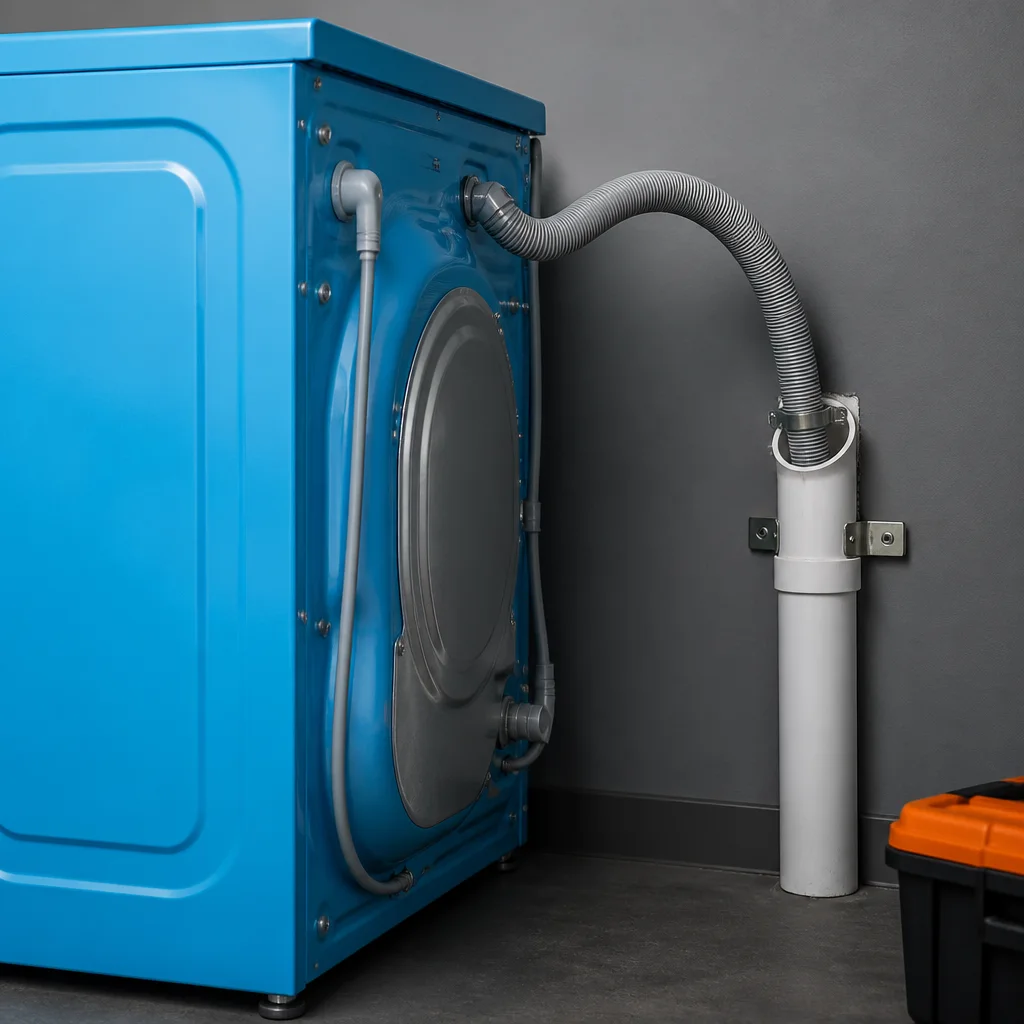
Pull the machine out far enough to see behind it and follow the hose from the cabinet to the wall. lg.com gives two things to look at: that the hose is not kinked anywhere along its run, and that it enters a standpipe no higher than 96 inches (8 feet) above the bottom of the washer, with no more than 4 inches of hose past the elbow bracket, which is what keeps the drain from siphoning back. aandeappliance.com gives the same 96-inch ceiling measured from the floor rather than from the bottom of the machine. If your standpipe is anywhere near that height, measure it both ways before you rule the hose out.
Cold weather matters here too if the machine stands in a garage or an unheated utility room. lg.com’s remedy for a frozen drain hose or pump is to pour warm water at 122°F to 140°F (50°C to 60°C) into the tub, leave it to soak for one to two hours to thaw the ice, and then drain.
What the sound the washer makes tells you
You will be starting the machine again shortly to see whether the drain is clear. When you do, stand beside it rather than walking away. A motor sound while it is trying to drain and complete silence are two different situations, and neither one on its own names the part at fault, so treat what you hear as a note to keep rather than a diagnosis. Write it down next to the code from the display.
Drain faults and what usually clears them
| What You Notice | Likely Cause | Where to Check | DIY Fixable? |
|---|---|---|---|
| OE code or standing water (failed to drain within ~10 minutes) | Foreign debris in pump filter or restricted impeller on front-load model | Front-load bottom-front service panel; unplug unit, drain water via black emergency hose, remove filter cap, clean debris, and check impeller | Yes |
| OE code or standing water | Kinked drain hose, standpipe height exceeding 96 inches (8 feet), or hose inserted >4 inches beyond elbow bracket | External drain hose routing and standpipe installation height above bottom of washer | Yes |
| OE code or standing water | Frozen water inside drain hose or drain pump | Tub assembly; pour warm water (122°F–140°F / 50°C–60°C) into tub and soak for 1–2 hours to thaw ice | Yes |
| OE code or standing water (failed to drain within 13 minutes) | Internal drain pump obstruction or pump failure on top-load model | Underneath tub assembly inside cabinet (no external filter or lower access door present) | No (Requires professional service) |
| How much of this you can do yourself depends on which kind of LG you own, because the two are not serviced the same way. The table sets them side by side, with the drain hose as the one check that runs identically on both. |
| What you are checking | Front-load LG | Top-load LG |
|---|---|---|
| Drain pump filter | Behind a service panel at the bottom front, behind a cap you turn by hand | None to get at: lg.com states these models have no external filter and no lower service access door |
| Getting the standing water out | Pull the residual water hose out from behind the same panel and drain it into a shallow pan | Bail it from the top, since there is no panel down there to open |
| Where the drain pump sits | Behind the service panel, reachable as far as the filter and the impeller in front of it | Underneath the tub assembly, inside the cabinet, as lg.com places it |
| Drain hose and standpipe | No kinks, and no higher than 96 inches above the bottom of the washer | No kinks, and no higher than 96 inches above the bottom of the washer |
| How far you get without opening the cabinet | Filter cleared, impeller checked, hose checked | Hose checked, and that is the end of it |
How to reset the washer and test the drain
If you came here looking for a reset in the sense that resetting an LG dishwasher means one, what happens here is simpler than that: the machine is only being asked to try the drain again. Plug the washer back in and run a cycle that drains and spins without refilling. Look on your control panel for a spin or a rinse-and-spin option, and check your manual if the wording on your model is different.
Run it as a test rather than as a fix, because what you are watching for is whether the drum empties now. If it does, put an ordinary load through before you call it settled. If the water stays where it is and the code comes back, both of the checks available from outside the cabinet have been made.
When the drain problem needs a technician
These are key points where you should stop and pass your observations to a technician if you are not prepared to open the cabinet or if the impeller will not move. On a top-load machine where the hose is clear, reaching the drain pump requires taking the machine apart, as the pump is mounted underneath the tub assembly inside the cabinet without a lower service access door. On a front-load model with a clear filter, if the impeller does not spin freely, the filter opening is as far into the pump as the bottom-front service panel lets you go.
When you book the visit, the two notes from the listening step are what you hand over, along with whether the machine has ever been moved or re-plumbed since it was installed.
How often should the drain pump filter be cleaned?
There is no interval you have to keep to. The useful trigger is what you notice: check it when a cycle finishes with water in the drum, when clothes come out wetter than they usually do, or after washing something that sheds heavily, such as pet bedding, sandy beach towels or a coat with full pockets. On a top-load LG the question does not arise, since there is no external filter to get at.
Is it safe to leave water sitting in the drum overnight?
If the filter has to wait for the weekend, the part worth doing tonight is getting the laundry out and the water down. On a front-loader the residual water hose behind the bottom panel empties the drum on its own, without unscrewing the filter. If the machine stands somewhere that drops below freezing, empty it rather than leave it full: lg.com’s remedy for a frozen hose or pump is warm water in the tub and a soak of one to two hours.
Can too much detergent stop an LG washer from draining?
It may be a factor, and it costs nothing to rule out by using the dose your cycle calls for. It is not something you can confirm by looking at the drum, though, and it does not change what you do next: the filter first, then the hose.
Does the washer need to be pulled away from the wall to check the drain?
Not for the filter. On a front-load LG it sits behind a service panel at the bottom front, so you work from the front of the machine with the floor covered. The hose is the part that needs room behind: checking it for kinks and measuring the standpipe height both mean seeing the back of the machine, which usually means pulling it out.
Work the checks in the order they appear here rather than starting at the pump, because the filter and the hose are the two places you can reach without taking the machine apart. If the drum still holds water after both are clear and the test cycle has run, what is left is inside the cabinet, and that is where the repair stops being yours.