If your Samsung washing machine stops with water still in the drum, start outside the machine rather than inside it. Samsung’s own guidance is to inspect the drain hose first and confirm it is installed correctly, then, on a front-load model, clean the pump filter. Those two checks cover the causes you can reach with a towel, a shallow tray and no tools at all.
What Samsung Washer Error Codes 5E, 5C, and nd Mean
A drain error is the machine reporting that the drum did not empty within the time its cycle allows, not that a named part has failed. Samsung lists nd, 5E, SE, 5C, SC, and 1 5C as no-drain error codes and says they mean water is not draining from the washer at the correct speed or at all. Which of those error codes your panel shows depends on the model and the display it was built with.
The code tells you the washer noticed. Finding where the water stopped is still yours to do.
Work from the outside in, in this order:
- Unplug the washer and empty the drum through the emergency drain tube.
- Straighten the drain hose and confirm it is installed the way the manual shows.
- Unscrew and clean the drain filter, on front-load models only.
- Check how far the hose sits inside the standpipe, and whether the standpipe itself is clear.
- Turn the drain pump impeller by hand and look for trapped debris or damage.
Samsung washer drain failure troubleshooting breakdown
| Symptom or error code | Most likely cause | Action plan |
|---|---|---|
| Error code 5E, 5C or nd | Clogged drain filter or a bent drain hose | Clean the filter, then check the hose for kinks and crushed sections |
| Slow drainage with standing water left in the drum | Partial clog in the drain hose or the filter chamber | Drain the residual water manually, clear the filter, and check the hose run |
| Humming from the base of the machine with nothing draining | Foreign object jamming the drain pump impeller | Unplug the washer, open the filter housing, and check the impeller turns freely |
| Water drains and then siphons back into the drum | Drain hose pushed too far into the standpipe | Pull the hose back to the depth your installation manual gives and hold it with a hose guide |
How to Drain Standing Water Safely
Unplug the Samsung washing machine at the wall before you open the lower access panel, and keep the plug where you can see it so nobody restores power while your hands are in the housing. Water left by a hot wash can still be hot, so test it before you reach in. Keep a shallow tray and more towels than you expect to need within reach, because the filter housing releases whatever the drum is holding and it will not stop when the tray is full.
Using the emergency drain tube
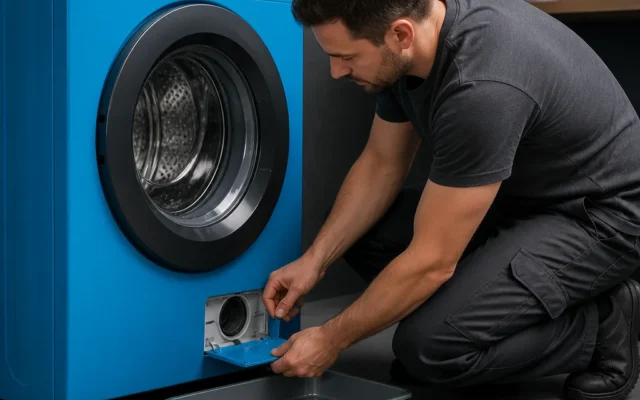
Behind the lower access panel of a front-load model, beside the filter cap, sits a short capped tube. Pull it free, hold it over the tray and remove the cap. The drum empties in stages — fill the tray, re-cap the tube, empty the tray, repeat — which is slower than pulling the filter straight out and far drier. Do it before you touch the filter cap, not after.
How to Clear a Clogged Samsung Washer Drain Hose
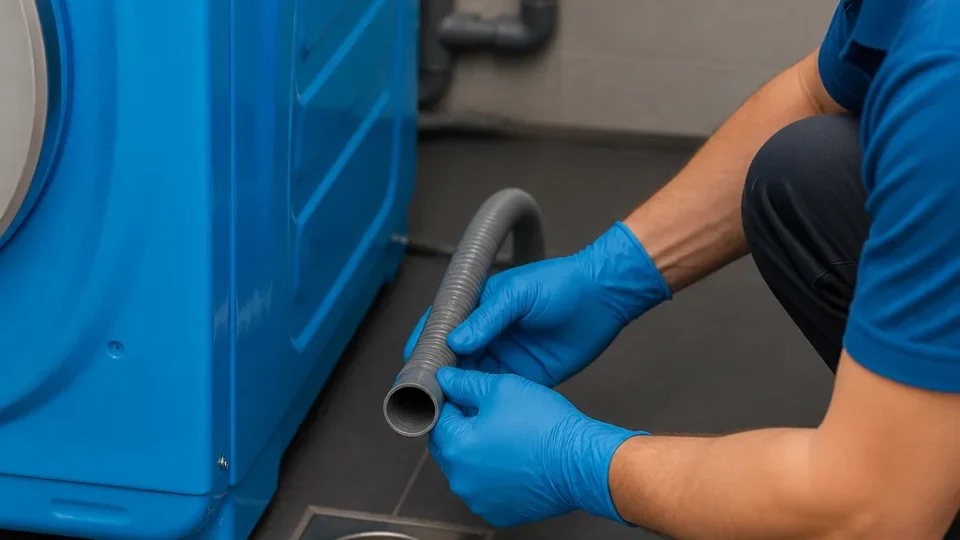
For Samsung washers that will not drain, Samsung recommends first inspecting the drain hose and confirming it is installed correctly, and that is where Samsung’s support guidance begins. Pull the machine out far enough to see the whole run of hose. A kink behind the cabinet, a length crushed against the wall, or a low loop holding water will stall a drain cycle while everything inside the machine works normally. Straighten it, support it so it cannot fold back on itself, and run a rinse-and-spin to test.
If the hose is clear and the drum still holds water, the blockage is further in.
Check the standpipe and how far the hose sits inside it
Two things matter at the standpipe: its height, and how far the drain hose goes into it. The trade-off runs both ways, since a hose pushed too deep lets the machine siphon drained water back into the drum, while one left too shallow can vibrate free mid-cycle and empty onto the floor. Your model’s installation manual gives the depth to use, and that is the figure worth trusting, because a depth quoted for a different Samsung model is evidence about that model. Hold whatever depth you set with a hose guide, then pour a jug of water down the standpipe with the hose removed: if it backs up, the blockage is in your household plumbing and no work on the washer will clear it.
How to Clean a Front-Load Samsung Washer Drain Pump Filter
For front-load Samsung washers with a draining problem, Samsung recommends cleaning the pump filter. Turn the cap counterclockwise, expect more water even after the emergency tube has run dry, then look at what comes out with it: lint, coins, hair clips and bra underwires are what typically reach the drain filter. Rinse it under a tap, clear the threads and the recess it seats into, and screw it back until it is firm, since a cap left loose will leak on the next fill. Cleaning it clears debris sitting in the filter chamber and does nothing about a blockage further down the line.
Where the drain filter is on a top-load model
Samsung top-load washers generally have no accessible front drain filter, so there is nothing to unscrew at the base of the cabinet. Drainage trouble on a top loader usually traces to a kinked drain hose, a blocked household standpipe, or the drain pump itself.
How to Inspect the Drain Pump Impeller for Obstructing Debris
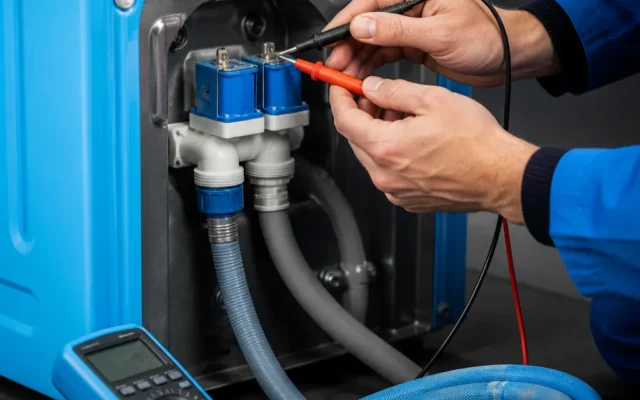
With the drain filter out, shine a light into the housing and turn the impeller by hand. It should spin freely, and a sock wound around the shaft or a coin wedged against the vanes will stop it. What this check cannot tell you is whether the drain pump motor is electrically sound, so an impeller that turns freely on a washer that still will not drain leaves the motor, the pressure sensor and the wiring between them untested.
Comparing Common Samsung Washing Machine Drainage Issues
A blockage and a failed drain pump look the same on the display and different in the drum. A blockage tends to drain slowly rather than not at all, improves the moment you clear it, and returns gradually as debris rebuilds. A pump failure is abrupt: the drum stays full, and either the pump hums without moving water or nothing runs at all when the cycle reaches its drain step.
The cheap way to separate the two is the order of work rather than a meter. Clear the hose, the drain filter and the standpipe, and if the machine then drains, no part needed replacing.
When to Contact a Repair Professional
If you have cleared the filter, unkinked the hose and inspected the pump impeller but your washer still refuses to drain, the drain pump motor or the main electronic control board may require replacement. Contact an authorized appliance repair professional to test those internal electrical components safely. Call sooner if you see scorch marks near the pump, smell burning, or find water reaching the floor from inside the cabinet.
Frequently Asked Questions
Where is the drain filter on a Samsung top-load washer?
Samsung top-load washers generally do not have an accessible front-door drain filter, so there is no cap to unscrew at the base of the cabinet. Drainage problems on a top loader are usually a kinked drain hose, a blocked household standpipe, or a failing drain pump. Check the hose and the standpipe yourself, and treat the pump as service work.
Why does my Samsung washer display a 5C or 5E code during the rinse cycle?
Samsung lists nd, 5E, SE, 5C, SC, and 1 5C as no-drain error codes and says they mean water is not draining from the washer at the correct speed or at all. Seeing one at the rinse stage is ordinary, because that is when the machine next tries to empty the drum and finds that it cannot. The usual causes are a restricted drain hose or a clogged pump filter.
How far should the drain hose go into the standpipe?
Far enough that it cannot vibrate free during the drain, and not so far that the washer siphons drained water back into the drum. Those are the two failures the depth is balancing, and the depth itself is model-specific, so use the figure in your installation manual rather than one quoted for another Samsung model. Hold it there with a hose guide.
A Samsung washing machine not draining almost always comes down to the same three places: the drain hose, the drain filter and the standpipe. Work them in order, unplugged, with a tray under the housing. You will end up either with a machine that drains, or with a much narrower question to hand a technician — whether the drain pump itself is still good.